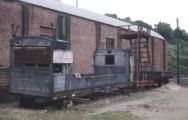
News from June 2008
Several TR staff members and volunteers have been staying at Trecwn, the former RNAD in Pembrokeshire, lifting rails ready to be transported up to Tywyn More …
Source: Talyllyn Railway: Latest News
Posted by Peter Bowyer on 5 June 2008
Those of you who have been following these postings on a regular basis will be up-to-date with all the latest happenings at Apedale. The new storage shed is now all but complete, and is now known as the Aurora North Shed (I’ll explain why another time). In the same way that nature abhorrs a vacuum, preservationists abhorr an empty shed. The MRT has a collection of more than sixty locomotives, mainly 2’0” but a few other gauges also, and these are scattered around the UK - with many in a storage unit in the Peak District. The Great Shoft, which will bring the collection under one roof at Apedale, has now commenced. Yesterday, Saturday 7/6/08, saw a trial load arrive from store, which conveyed two locomotives – a Class M Orenstein & Koppel petrol loco – OK4470 of 1930, and a 60S type Motor Rail, number 11142 of 1960. The Motor Rail is a good runner, and will be the prime passenger loco for non-steam trains – and also the mobile air compressor for non compressor fitted locos – especially steamers. It’s a bit of a beast to drive!
Also arriving on 7/6/08 was a Hibberd, FH2586 of 1941, which had been in store at a member’s house in Yorkshire. This one is perhaps best described as a long-term project. Anyway, it’s all jolly exciting.
The influx of locos now looks set to accelerate over the next few weeks. The best opportunity to see all the its happening at Apedale is our September Open day, check out details
here. As ever, we’d be glad to see new members – especially workers – get in touch
here.
And why a Shoft? Well, let’s just say we’re not employed for our typing skills.

Source: Moseley Railway Trust – Latest News
Posted by Peter Bowyer on 8 June 2008
In these notes we have mentioned the
WDLR organisation a few times. This was the War Department Light Railways organisation, formed during the First World War by the British. 2008 is, of course, the 90th anniversary of the end of the Great War, and thus many thoughts inevitably turn to this conflict. The early years of
WW1 compelled a revolution in military logistics; the war had bogged down into a static slogging match. In such a war of attrition, the rate of consumption of material is huge, and this caused major problems. Most of the combatants had foreseen these issues – the Germans and the French being perhaps most advanced, although with different philosophies deriving from their intentions; the French saw their railways serving fixed defensive positions, whereas the Germans intended to use railways to serve an advancing front line. Narrow Gauge railways, with their inherent limited requirements for civil engineering and their flexibility, were the ideal tool for moving material from standard gauge railheads to the front lines. Furthermore, it was also rapidly discovered that steam locos with their all-too-visible smoke emissions, were far too visible on a battlefield with very active artillery spotters on both sides. This gave the impetus to the development of the very earliest internal combustion locomotives.
The British
WDLR, although late in recognising the benefits of narrow gauge railways, adopted a number of new and existing locomotive designs, both steam and internal combustion. The full weight of the colossal British manufacturing industry started to churn out locomotives, wagons and other equipment. The unexpected collapse of the German military in late 1918 produced huge amounts of surplus railway equipment, both in France and in huge dumps in the
UK (which truly must have been a sight – bring on the time machine!). Much of this equipment formed the machinery used in the industrial narrow gauge railways which sprung up and modernised after the war – many a quarry or factory used
WDLR surplus locomotives. The equipment was astonishingly long-lived and robust considering the short expected life of military railways and their vehicles. This meant that a number of
WDLR locomotives and wagons came to be preserved, and the Moseley Railway Trust is slowly gathering such equipment at its Apedale base, in North Staffordshire. The upper photo shows a “Protected” Motor Rail 40HP loco, maker number 1369, which is part of the
MRT collection (on loan from Leeds Museums). This loco was restored as part of the Salvage Squad TV programmes a few years ago. These locos were fitted with bodywork to improve the protection for the crew when running in dangerous areas. The second photo shows Motor Rail 1320, which began life similar to no.1369, but was heavily rebuilt in civilian life at gravel quarries in Hertfordshire. All being well, both of these locos will be on show at the Moseley Railway Trust’s open days in September, see
here. As ever, we’d love to hear from you –
here.Moseley Railway Trust – Latest News
Posted by Peter Bowyer on 15 June 2008
The Battle of the Atlantics.
Our Atlantic Fleet formation will be;
Flagship Basset Lowke class 30 Synolda
Line of Battle.
Sutton Collection Sutton Belle
Sutton Flier
Barnes Albion Joan
Escort Group The glorious 0-4-0 Pet
Basset Lowke class 10 Prince of Wales
Air & Ground support The KLR’s own Hawk
Owl
Fox
Badger
Search & Rescue The KLR’s diesel Jay
Plus some surprises.
An intensive train service will be operatedtogether with a display of vintage vehicles and models.
At Clayton West the Wortley Top forge engineers will be holding a mini gala on our 7 1/4 ” line.
Our thanksto the friends at Ravenglass, Rhyl, Sherwood Forest, Cleethorpes and Windmill Farm for making this line up possible
Posted by peter levick on 17 June 2008
Keith Theobald reports that the New Rail Fund now stands at a magnificent £45,000 pounds thanks to the generosity of the membership. A big thank you to everyone who has contributed.
The forthcoming Outdoor Week will see plenty of activity around sorting the new material and scrapping other material that we no longer need to keep in reserve.
One evening during Outdoor Week there will be a session in the Slater Room with pictures of operations at Trecwn.
Below are some photographs of the work at Trecwn, where several staff members and volunteers have been taking up the rails and sleepers ready to bring to Tywyn. _June_2008.html”>Talyllyn Railway: Latest News
Posted by Peter Bowyer on 25 June 2008
It’s been another busy weekend at Apedale, the home of the Moseley Railway Trust. The Great Shoft has continued, with another lorry load of locomotives arriving to take up residence in the Aurora North storage shed. The first was a modern Simplex Mechanical Handling loco, 40SD516 of 1979. This loco worked for Severn Trent Water at their Minworth works near Birmingham. The top photo show the loco in industrial days at Minworth, crossing the road (probably at a speed somewhere near Warp factor five) which bisected the Minworth site. The second arrival was a large 48DL Ruston, 235730 of 1943 – this one worked for most of its life at the Royal Naval Armaments depot at Broughton Moor in Cumbria. The third arrival was a 2’6” gauge battery electric, also with an explosive past – it spent its industrial career at the Royal Ordnance Factory at Bishopton, Scotland. This is one of the rare Brook Victor locos, number 565 of 1970. This loco posed a slight problem on arrival. It is 2’6” gauge, and with great foresight, we built 2’6” gauge track for it to run on. Unfortunately, the loco was unloaded at the wrong end of the site for this part of the railway. Ingenuity was therefore employed to move the loco a few hundred yards on two 2’0” gauge flat wagons to the safety of the shed. One of our members was heard to comment that it looked like an electric version of a Shay logging loco. The final photo shows the Ruston and 40SD516 sitting outside their new home in the company of long standing stalwart
MR8748. All of these delights and many more are yours for the taking (of photos, that is) at our open days on 13 & 14 September – details
here. And, as usual, do get in touch if you want to help or just for a chat
here.
Source: Moseley Railway Trust – Latest News
Posted by Peter Bowyer on 24 June 2008
The Vintage Train is running again this year _20th_June_2008.html”>Talyllyn Railway: Latest News
Posted by Peter Bowyer on 28 June 2008
These pictures show the first of the rail from Trecwn reaching the rail stack on the evening of Wednesday 18th June 2008. More …
Source: Talyllyn Railway: Latest News
Posted by Peter Bowyer on 28 June 2008
Hosting NGH & Isengard costs me £20/month. Will you
help me cover this cost?
Site sponsored by Maple Design - please support them!